The World’s Greatest Book

I‘m Dave Bricker: author of fiction and nonfiction, editor, graphic designer, interactive developer and MFA design educator. I help writers turn well-crafted manuscripts into beautiful, high-quality books. My website offers straight talk for writers about producing and marketing excellent books, eBook technology, book design, typography, writing, literacy and the publishing business.

Originally named OneHourSelfPub.com (after my self-publishing book), this site is now called TheWorldsGreatestBook.com. That’s what serious writers and publishers are trying to accomplish.

Thank you for reading. Enjoy your publishing journey.

—Dave Bricker

GD Star Rating
loading...

Recent Publishing News Recap from TheWorldsGreatestBook.com

Self-publishing has seen a host of new eBook technologies announced in recent days. Moves to apply sales tax to digital downloads will soon impact publishers’ pricing and revenue models.

Amazon’s announcement of new tools and support for new features in Kindle KF8 format was big news last week until it was eclipsed by Apple’s launch of iBooks-Author, a visual tool that allows self-publishers to create interactive eBooks in a visual, drag-and-drop environment. The tool is exciting, but the web is alive with debate over the terms of Apple’s EULA (End User License Agreement); iBooks produced with iBooks-Author can only be distributed through Apple’s iBookstore.

Meanwhile, other innovators are quickly developing eBook publishing tools in anticipation of Reader devices becoming ePub3 compliant. Developers are racing to capture “rich eBook” opportunities while publishers hold out for standards-based tools and readers.

Read More Self-Publishing News→

GD Star Rating
loading...
Leave a comment

Have You Got Any Castles? Looney Tunes Bookstore Animation

town crierHave You Got Any Castles? is a Looney Tunes cartoon short released on June 25, 1938 as part of the Merrie Melodies series produced by Leon Schlesinger and distributed by Vitaphone. The first Looney Tunes‘ bookstore animation of two, the plot consists of puns on book titles and literary characters.

I originally posted a YouTube video of the short that some one else put online, but a friend correctly pointed out that I was not making proper use of copyrighted material. As a writer and publisher, I think it’s important to respect that so I have taken the actual clip off my site.

The second Looney Tunes bookstore video, Book Revue is a Looney Tunes cartoon short featuring Daffy Duck, released in 1946. It was directed by Bob Clampett, written by Warren Foster and scored by Carl Stalling. Mel Blanc and Sara Berner provided the voices. The title is a pun; a Revue is a variety show, while a Review is a critique. Notice the wonderful hand-lettered book titles. See it on YouTube here.

I will continue to round up animated and artistic works that celebrate books and publishing. Send me a link if you know of something remarkable you think I should share.

GD Star Rating
loading...
Leave a comment

Book Design Basics – Drop Caps and Initial Impressions

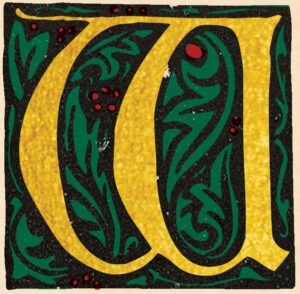
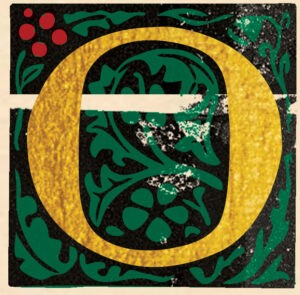
NITIAL CAPITALS have historical roots in the early days of book design; their use predates the printing press and the invention of moveable type. Today’s initial caps are not as fancy as those carefully rendered in gold leaf in ancient scriptoriums, but their association with classic book design remains strong. Initial Capital letters are often referred to generically as “drop caps” though a drop capital is actually a specific style of Initial Cap.

Some modernists discourage the use of initial caps, citing a host of typographical problems, but “Once upon a time” just wouldn’t be the same without a great big letter “O” at the beginning. Though not appropriate for every book, initial caps announce the beginning of a chapter with classical style. They suggest that the text you are about to read transcends mere data; this is literature.

illuminated Initial Cap
Illuminated letter P in the 1407 AD Latin Bible on display in Malmesbury Abbey, Wiltshire, England

This post examines different styles of initial caps and discusses the challenges of transitioning smoothly from large initial characters to the much smaller characters of body text. Digital tools and shortcuts make it easy to create initial caps but the easy way isn’t always the best way. Serious publishers understand the subtle differences between good typography and great typography. Many thanks to author and typographer Dick Margulis for editing and fact-checking.

Read More About Book Design →

GD Star Rating
loading...
Leave a comment

iBooks Author – Apple Introduces Easy eBooks with One Big Condition

iBooks-Author LogoIBooks Author is Apple’s new eBook publishing application, a drag-and-drop tool that allows publishers to create interactive books without having to write code.

From Apple: Available free on the Mac App store, iBooks Author is an amazing new app that allows anyone to create beautiful Multi-Touch textbooks — and just about any other kind of book — for iPad. With galleries, video, interactive diagrams, 3D objects, and more, these books bring content to life in ways the printed page never could.

Notwithstanding the fact that books have hardly failed to bring content to life these past five centuries since the introduction of the printing press, iBooks-Author looks pretty slick. However, Apple’s latest offering comes with sticky licensing restrictions that are unprecedented in the software industry.

Read More about iBooks-Author –>

GD Star Rating
loading...
2 Comments

The Joy of Books

After organizing their bookshelf, Sean Ohlenkamp and his wife decided to take it to the next level. They spent many sleepless nights moving and stacking books at Type Bookstore in Toronto to produce this whimsical stop-motion animation.

GD Star Rating
loading...
2 Comments

KF8 EBook Tools and Documents Released by Amazon

Kindle FireAmazon has released early tools and documents for producing ebooks in the new KF8 format.

A more thorough tutorial on KF8 will follow in an upcoming post, but here are links to Amazon’s KF8 tools and documents along with links to relevant articles.

The Kindle Format 8 Home Page - includes links to the Previewer, KindleGen, and supporting documents.

KindleGen2 – A command-line application for creating KF8/Mobi ebooks from X/HTML and ePub, this tool is probably too technical for most self-publishers. However, the ability to convert from ePub files to KF8 files is notable. Because all other eReaders use ePub files, the most efficient workflow will likely involve exporting a single ePub or ePub3 file for distribution across eBook stores and then converting that same file into Kf8 for distribution by Amazon.

Read More About Kindle KF8→

GD Star Rating
loading...
3 Comments

WordPress – Websites for Writers and Publishers Part 1

WordPress is a magic web publishing tool perfect for writers and publishers who want to build attractive websites without spending a fortune and build reader communities around their work. This is the first in a series of articles that explain in non-technical terms how to get your site started and how to publish content without becoming a programmer. Search engines and marketing strategies will be discussed and I’ll steer you around common stumbling blocks.

Over 70 million WordPress sites (including the one you’re currently reading) produce over a half-billion new posts every day. Other good options are available, but WordPress offers a huge support community, thousands of add-ons (plug-ins) that extend its functionality and thousands of themes that instantly customize its appearance. WordPress is fantastically search engine friendly.

WordPress was originally developed as a blogging platform that enables writers to post articles and receive comments from readers. Eventually, WordPress expanded into a full-blown content management system. In English, this means you can post articles, create pages, embed images and publish many kinds of content with a simple Microsoft Word-style editor. Push the “Publish” button and your content magically appears on your website along with whatever links or navigation buttons are needed.

Continue reading

GD Star Rating
loading...
4 Comments

What Graphic Designers Do (Article for GraphicDesign.com)

My latest article on GraphicDesign.com discusses the difference between designers and production artists.

What exactly is design? Do designers build projects or do they have a larger and more valuable role. What do designers really do? How can you find clients who understand the value of creative insight and quality work.

I pondered these things on an airplane on the way to a consulting job, then brought the questions back to my classroom.

Read the article at http://www.graphicdesign.com/commentary/what-graphic-designers-do/

GD Star Rating
loading...
Leave a comment

Writer’s Software Review: AutoCrit Rocks!

Can a computer analysis of your text help you write better? I gave AutoCrit a spin and became a customer.

It is often difficult to see mistakes in your own manuscript, but overused adverbs, repeated words, passive writing, too much introspection, and other patterns can be easily recognized by a computer. Author, Nina Davies used her background as a computational linguist (someone who works to make computers understand human languages) to develop the AutoCrit Editing Wizard. The wizard automatically finds and highlights potential problems in your text.

According to the AutoCrit site:

AutoCrit is a tool to help you identify weaknesses in your fiction writing. AutoCrit can help you identify:

  • Words that weaken your writing, such as too many occurrences of “that” or “it” or LY-adverbs.
  • Repetition of similar words.
  • Sentences that lack variety due to similar lengths.
  • Overuse of dialogue tags such as “she muttered.”

AutoCrit is not a grammar checker or a spell checker. AutoCrit identifies problems that prevent the reader from your enjoying story.

  Read More About AutoCrit →

GD Star Rating
loading...
2 Comments

Indie Publishers, Bookstores and Readers – the Indie Ecosystem

back2backIndie publishers are everywhere and so are indie bookstores, but apart from their names, the two have little in common. “Independence” is a feelgood concept, but it’s often presented without any reference to that which a publisher or bookstore is independent from. Therein lies the difference. Does “independent” really mean anything in today’s publishing world?

Independent publishers are independent from the Big Six publishing establishment, but not being affiliated with six entities isn’t much of a distinction. For publishers, independence comes with a price. After writing, indie publishers must work independently with editors, designers and printers. They must make their own arrangements with distributors of print and ebooks. Perhaps most importantly, they must independently assess whether books they have a great personal stake in are viable products. Indie publishing isn’t better or worse than traditional publishing. There’s much to be said for having someone else push your manuscript down the long road to bookstores and there’s much to be said for cutting out the middleman and keeping creative control over your work.

Indie publishers generally sell books to niche audiences in lower volumes. They usually offer one or just a handful of books. Unlike big publishers, they aren’t able to circulate and promote hundreds of books until they find a blockbuster that pays for all the ones that don’t sell, but they are often positioned to make a profit with very low sales volumes.

Read More About Indie Publishers and Bookstores →

GD Star Rating
loading...
3 Comments